
Understanding Flush Technology Efficiency
Evolution of Toilet Design and Water Demand
Pre-1990 toilets in South Africa can waste up to 20 litres per flush. That is a shocking waste for a country where droughts are routine! Toilet design evolved in direct response, shrinking cisterns while preserving performance.
Gravity remains the primary mechanism, but we now have modern trapway sizing and rim jets that clear waste with six litres or less. This efficiency is what makes a true water saving flush possible.
- 1970s: 17 litre single-flush
- 1990s: 9 litre dual-flush
- 2020s: 4.5 litre pressure-assist
Each generational shift reduced water demand without sacrificing function. For South African households, we see lower municipal bills and less strain on reservoirs. Efficiency is no longer an upgrade; it is a daily necessity.
How Dual-Flush Mechanisms Work
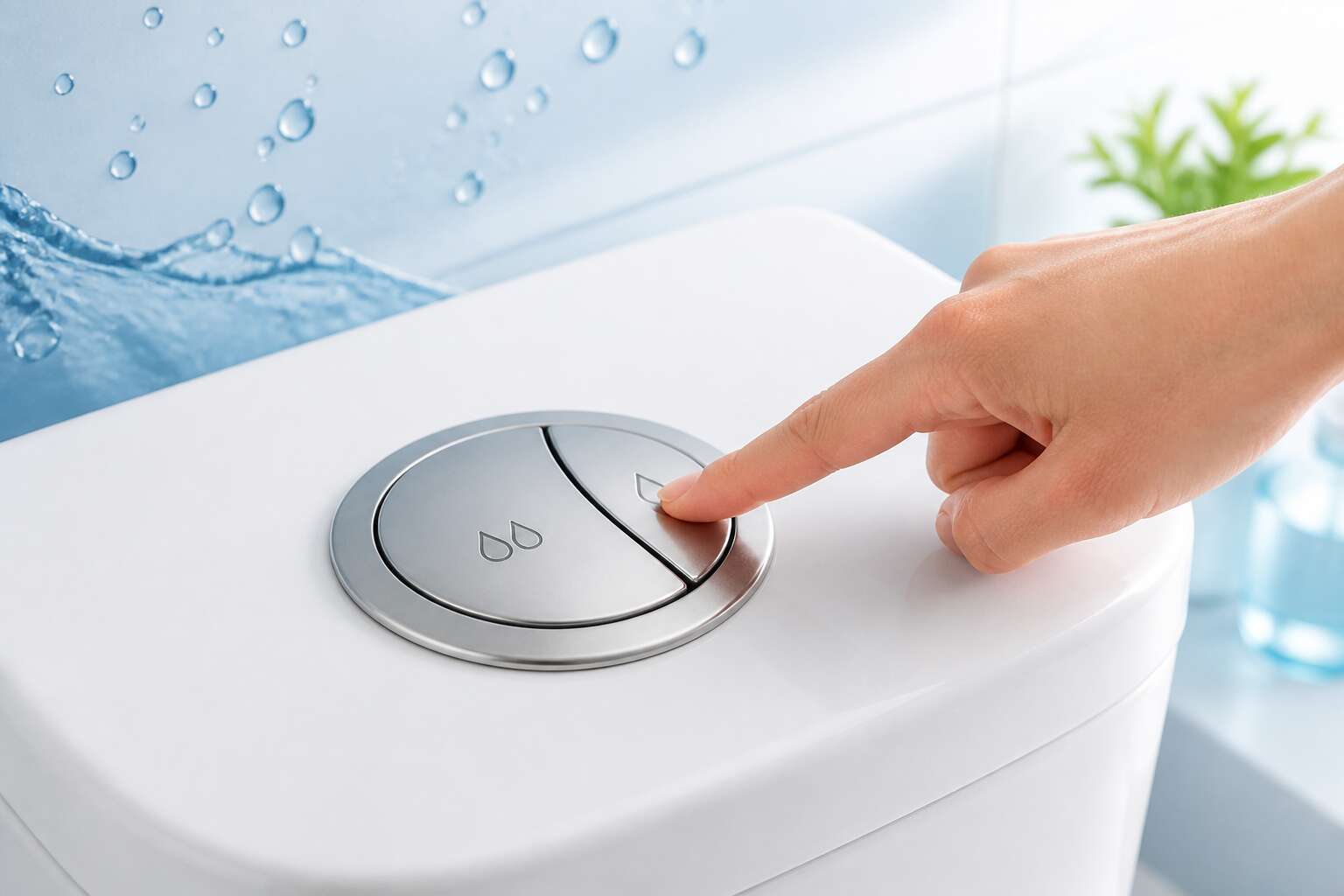
Two buttons. A single flush. That small choice can save thousands of litres each year, turning a daily necessity into an act of conservation. The dual-flush system operates on a simple principle: different waste requires different water volume.
The mechanism uses two distinct release valves. The smaller button, often labelled with a single drop, empties a reduced volume of water. This option is designed for liquid waste and uses roughly three litres. The larger button releases the full cistern capacity, around six litres, providing the necessary force for solid waste.
– The short flush opens a larger valve opening, allowing water to escape rapidly for a quick, partial drain.
– The full flush employs a different drop mechanism, holding the water back until the entire cistern empties for maximum clearing power.
This clever engineering delivers power where needed and efficiency where possible. For homes facing water restrictions or rising utility bills, this mechanism offers a practical, daily reduction in consumption without any compromise on hygiene. It is a straightforward upgrade that quietly works every single time you use it.
Gravity vs. Pressure-Assisted Flushing
Gravity flush systems dominate the South African market. They rely on falling water alone, storing potential energy in the cistern and releasing it through the flush valve. Pressure-assisted flushing works differently. It traps air inside a sealed tank and compresses it with mains pressure, generating a concentrated burst that clears the bowl rapidly.
For anyone pursuing a water saving flush, this distinction matters. A pressure-assisted system clears the bowl in one decisive action, whereas gravity systems sometimes require a second flush. That second flush cancels out the savings from reduced volumes.
Gravity remains common in residential installations:
- It operates silently and requires no special plumbing
- Its components are inexpensive and widely available
- It performs well where mains pressure is inconsistent
Pressure-assisted systems suit commercial settings and households with strong water pressure. They deliver more force per litre and reduce flush frequency. The trade-off is audible noise and a more complex valve assembly. Gravity remains the pragmatic choice where mains pressure fluctuates, which is common across South African municipalities.
What Constitutes a High-Efficiency Toilet
Walk into any plumbing supply store and you will see identical looking toilets that behave differently. The litre rating on the packaging tells you the volume, not the outcome. True efficiency measures how completely the bowl clears, not how little water you feed it.
There is a measurable standard! South African flush performance tests track waste extraction distance. A high-efficiency toilet moves solid matter a set distance using a set volume. If it falls short, flush performance is questionable.
What I look for in a genuine water saving flush:
- Flush volume of 4.5 litres or less for full flush
- Waste extraction distance over 15 metres under test conditions
- Complete bowl rinse with a single activation
These three markers separate a real water saving flush from a valve merely metering water. Manufacturers quote volumes, but extraction distance reveals hydraulic performance. A toilet that passes these tests will not force a second flush.
Comparing Flush Volumes: Past and Present Standards
Walk into any bathroom in 2025, and you will likely find a ceramic throne that claims miraculous water savings. The labels shout numbers at you: 9 litres, 6 litres, 4.5 litres. Yet the difference between a water saving flush and a mere trickle is not the volume knob on your cistern. The real metric is kinetic energy. Flushing efficiency in the modern era is a physics problem, not a plumbing preference.
By the early 2000s, the South African landscape was littered with toilets that used 11 litres per flush. That volume moved waste, but at a brutal cost to municipal water reserves. We have since inverted that logic. A water saving flush now uses less liquid, but engineers harness the pressure of a smaller column to create a powerful surge. The litre count dropped, but the flush velocity increased. The game shifted from raw quantity to applied force.
However, the shift from old standards has created a market of impostors. A toilet with a 4.5 litre tank that fails to clear the bowl on the first press is not efficient; it is a nuisance that requires a second activation. That second flush doubles water consumption, making your “water saving” fixture a horrifying mockery of its purpose. The performance tests agree on specific markers to judge these systems:
– A full flush volume that never exceeds 4.5 litres.
– A waste extraction distance of at least 15 metres.
– A complete bowl rinse achieved with a single activation.
The mechanics involve a more specific nozzle geometry and a wider trapway. Old toilets used a narrow trapway with a lot of water pushing through it. New efficient models use a wider trapway that allows matter to slip through with less resistance. This engineering change means the water saving flush uses less volume because the path is easier to clear. The pressure differential does the heavy lifting, not the sheer weight of the water column.
Comparing past models to current units highlights the progress. The 11 litre behemoths were sledgehammers. The modern water saving flush is a surgical strike, precise and calculated. The measurement of efficiency lies in the viscous shear of the water against the porcelain. If the toilet cannot push waste over a set distance with a minimal amount of liquid, the design is a failure, regardless of the sticker on the box. The standard remains the only honest translator of hydraulic performance.
Benefits of Reducing Water Consumption Per Flush
Environmental Impact and Conservation Efforts
South Africa’s water infrastructure strains under growing demand, and every flush that uses less water becomes a small act of resilience. A water saving flush reduces the volume drawn from rivers and aquifers, which matters in a region where drought cycles are no longer anomalies but expectations.
The environmental advantages extend further! Less water flowing through sewer networks means reduced load on treatment plants, translating to fewer chemicals and lower energy inputs. Specific benefits include:
- Reduced strain on municipal treatment systems
- Lower energy for pumping and heating
- Preservation of aquatic habitats
Conservation efforts target the largest residential water uses, and toilets historically account for a significant share. Municipalities across South Africa now incentivise retrofits, so homeowners who switch to such a fixture contribute to a broader pattern of demand reduction.
Lower Utility Bills for Households and Businesses
Every flush sends money down the drain. A standard older toilet can consume 15 litres per flush, while a water saving flush uses a fraction of that. For a household of four, the annual savings on the municipal bill are hard to ignore!
Businesses feel this even more acutely. Office blocks and retail centres flush constantly throughout the day. Installing a water saving flush across multiple restrooms shifts the monthly municipal statement. The savings compound with each cistern converted.
The numbers are straightforward:
- A single flush reduction of 6 litres saves roughly 4,380 litres per person each year
- Commercial properties with high traffic can recover retrofit costs within months
Lower consumption also defers the need for expensive infrastructure upgrades, which municipalities ultimately pass on to ratepayers. In my view, every property owner who reduces water demand keeps costs predictable in a pricing environment that keeps climbing.
Reducing Strain on Municipal Sewer Systems
The flush cycle ends, but the story continues deep beneath the ground. Every litre you send leaves your home and enters a municipal sewer system that has no patience for inefficiency. A water saving flush trims that input at the source. By releasing a smaller volume, you shorten the distance for pressure to travel. This means pumps do not strain against a heavier column of water, and the network stays within its designed comfort zone.
Ask any maintenance engineer, and they will tell you the same:
- Lower flows allow grit and debris to settle, which reduces the chances of serious blockages.
- Short, controlled surges are easier for pumping hardware to handle without frequent breakdowns.
- Plant operators face a steadier, less surprising inflow pattern throughout the day.
In South African neighbourhoods, where pipes often take strain from years of weather, careful reductions in basic flow relieve more than just headaches for infrastructure teams. They keep the entire network honest in the process.
Contribution to Green Building Certifications
Green building certifications measure more than energy. In South Africa, the Green Star SA framework awards significant points for water efficiency, and every fixture in a building counts toward that score. A water saving flush can shift a project into a higher rating band without costly retrofits. That is the opportunity most owners overlook.
Consider the documentation that assessors review:
- Sanitary fixture flow rates are verified against submeter data.
- Reduced flush volumes lower the building’s total water use intensity.
- Consistent performance across tenants strengthens the submission.
I have seen projects in Johannesburg earn an extra credit simply by standardising all toilets with a water saving flush. Those points translate directly into a measurable asset value. One fixture type, properly specified, can determine the final rating band! The assessor sees a coherent water strategy across every floor.
Preserving Water Resources in Drought-Prone Areas
Cape Town’s Day Zero crisis in 2018 was not a warning, it was a rehearsal. The residential toilet alone consumed up to 30% of indoor water in older buildings, and a single full flush from a pre-2000 cistern could release 13 litres of drinking water directly into the sewer. A water saving flush changes that ratio at the source.
It reduces the volume drawn from municipal supply and the volume returned to the sewer. Both matter in a country where bulk water infrastructure operates near capacity. When a building reduces flush volume from 11 litres to 6 litres, the saving is not theoretical. It is measurable on the meter and visible on the municipal invoice.
– A household flushing 12 times per day saves over 20,000 litres per year with a 6 litre flush.
– A commercial building with 50 toilets saves roughly 1.8 million litres annually.
– A dual-flush mechanism using 3 litres for liquid waste cuts water demand by half.
The benefit extends beyond the property boundary. Municipal authorities must treat less wastewater and pump less potable water. In a drought-prone region, every reduced flush lowers the pressure on reservoirs. The water saved becomes available for agriculture and industry. The water saving flush is the most accessible efficiency measure a building owner can implement today.
Key Features to Evaluate in High-Efficiency Toilets
Dual-Flush Buttons and Lever Controls
The dual-flush button is the primary interface between household habit and municipal water supply. In South African homes, every litre carries weight. A firm press on the half-flush button should deliver 3 to 4.5 litres, while the full flush handles heavier loads. Durability deserves scrutiny, since a sluggish button often leads to double-flushing, defeating the purpose of a water saving flush.
Lever controls offer a different ergonomic experience, and for those raised on this style, the water saving flush comes naturally. A single lever rotating in two directions provides intuitive access without fine motor control. Older residents and children often struggle with separate buttons, making levers appealing for multigenerational households. I have seen cheap actuators fail within a year!
Key quality indicators include:
– Ceramic valve seals that resist mineral buildup from hard South African water
– Metal or reinforced polymer actuators that survive hundreds of thousands of cycles
Flush Volume Options and Adjustable Settings
Fixed flush volumes treat every household the same, but real plumbing rarely cooperates. A water saving flush should adapt to the actual conditions in your home. In South Africa, municipal pressure can swing between 200 kPa in the morning and 700 kPa at night, so a valve that cannot adjust will either waste water or flush weakly.
Check these features before you buy:
- Selectable flush volumes between 3 and 6 litres
- Adjustable fill valves that respond to low-pressure reticulation systems
- Replaceable flush cartridges that allow volume changes without replacing the whole cistern
That last point matters more than the sticker price. Swapping a cartridge costs a fraction of a new toilet and extends the practical life of a water saving flush installation. An adjustable system turns a generic fixture into something tuned for your specific plumbing.
Bowl Design and Waste Clearance Performance
The bowl wall’s contour deserves honest inspection before you trust any label. A well shaped basin focuses the water column into a single swirl, which lets a water saving flush clear waste with 4.5 litres instead of six. In South Africa, the municipal pressure can drop to 200 kPa at dawn and jump to 700 kPa after midnight, so a shallow or poorly angled bowl will force a double flush.
Waste clearance performance is mostly dictated by the trapway outlet. A wider channel with no internal ledges reduces the work your pressure needs to do. The glaze quality matters equally; a porous surface drags on every speck, while a vitreous finish stays frictionless. Inspect the inside with a small mirror if the lighting cooperates.
Check these three markers during a showroom visit:
- The throat width at the dam, not the distant rim
- The curved steepness of the drop away
- The smoothness of the floor channel turn
Each component quietly pushes the water ahead. Without them, a toilet becomes a decorative anchor in your bathroom, hungry for one rinse after another.
Flush Power and Clog Resistance
Flush power comes from how water moves, not from volume alone. A toilet that releases a quick burst will outwork a lazy trickle of the same litres. Check the siphon action at the bottom of the bowl, the force that pulls waste upward and out. A gradual release loses momentum, while a sudden surge clears the line.
Clog resistance depends on the discharge pipe’s diameter and the valve’s responsiveness. A smooth inner surface lets a water saving flush move waste without snagging. Ask about the valve’s opening speed, since a rapid full opening creates a stronger pull than a slow one.
- The valve’s opening speed
- The discharge pipe’s inner diameter
- The siphon’s angle of attack
These three markers tell you more than any efficiency label. In South Africa’s variable pressure, a toilet that clogs once can erase the savings from a water saving flush!
Installation and Retrofitting Options for Existing Bathrooms
Replacing an Old Toilet with a High-Efficiency Model
A single outdated toilet can silently send hundreds of litres down the drain daily. That waste hits municipal bills and water reserves with equal force. Swapping out an old fixture is a direct remedy.
Retrofitting kits convert a standard cistern into a dual-flush unit. They are inexpensive and easy to fit. But a full replacement with a high-efficiency model delivers the most reliable water saving flush. New bowls and valves are engineered together for optimal clearance.
Consider replacement when you notice:
– Cracks in the porcelain
– Stains that return after cleaning
– A handle that sticks or breaks often
These signs indicate hidden leaks and growing inefficiency. A modern unit uses far less water than older fixtures, making the investment worthwhile for any South African home.
Installing a Flush Valve Conversion Kit
The most practical solution for an existing bathroom often arrives as a retrofit kit, not a new fixture. A standard 9 to 11 litre cistern can become a water saving flush unit with a simple valve swap. This modification introduces a dual flush plate and a new diaphragm mechanism that separates liquid and solid cycles, effectively halving consumption for common use. The entire project usually takes under an hour, requiring only a flathead screwdriver and a pair of pliers. For the average South African household, the resulting reduction in municipal consumption is immediate.
The conversion process follows a straightforward sequence, though attention to the rubber seal is crucial.
- Isolate the water supply and drain the cistern completely.
- Detach the existing flush handle and lift out the old siphon assembly.
- Align the new drop valve over the outlet, then secure the locking nut beneath the pan.
- Connect the dual flush button mechanism and refit the cistern lid.
I have found that the most common mistake involves overtightening the nut, which distorts the washer and causes a constant trickle. A subtle hand tightness with a final quarter turn is sufficient. Once fitted, the unit repurposes your existing porcelain, eliminating the carbon cost of manufacturing a new bowl. This approach proves particularly valuable in older homes where the trapway size may not align with modern low-profile designs. As a result, you retain the original fixture’s clearance while finally achieving a reliable water saving flush.
Adjusting Fill Valves and Flapper Seals
Some fixtures need no grand intervention, only a tender devotion to detail. In South African homes where replacements are not yet viable, the fill valve and flapper seal become quiet instruments of conservation. I have found that a toilet continuously running at night is often the result of a simple, aged flapper that no longer sits flush against its seat. Correcting this is less about new hardware and more about recalibration. A mere twist of the fill valve screw can lower the water level by a precious litre, and that adjustment alone changes the character of the water saving flush. Consider these gentle checks:
- Inspect the flapper for mineral build-up or warping after years of chlorinated water.
- Adjust the float arm so the cistern refills to a lower line without compromising pressure.
- Clean the valve seat with a cloth to ensure a perfect seal during the flush cycle.
These small acts make the existing mechanism honest again. The rewards appear on the municipal bill, quietly and without drama. In a country where every drop is rationed by drought, the ability to tune what you already own carries a certain dignity. It is the difference between waiting for change and commanding it with your own hands.
Compatibility with Older Plumbing Systems
Retrofitting an older toilet for a water saving flush is a practical upgrade for many South African homes. The challenge lies in the fact that older plumbing systems and cisterns were designed for a different era. They often rely on a syphon mechanism rather than a flapper valve, which dictates how you can adjust the flush volume. You cannot simply drop in a modern dual-flush valve without first assessing the condition of your existing pipework and the cistern’s internal dimensions. The space constraints and the water pressure in your specific municipality will determine the viability of a full conversion kit.
For those with a syphon-based system, the simplest path to a water saving flush involves modifying the drop valve or fitting a displacement device. You can address this by inserting a cistern displacement bag or a brick in a sealed plastic container. This reduces the volume of water used per flush without altering the mechanics. However, you must ensure the flush still has enough power to clear the waste. A more permanent solution involves installing a dual-flush syphon, which provides a button-operated partial flush option. This part is often compatible with older cisterns but requires careful measurement of the syphon’s height and diameter to match your existing unit.
When considering the plumbing connection, a crucial point of concern is the inlet valve. Older installations might feature a brass or plastic float valve that is prone to leaking under higher mains pressure. If you are retrofitting a water saving flush mechanism, it is advisable to replace this with a modern pressure-reducing inlet valve. This prevents the cistern from refilling too aggressively, which can cause a constant trickle and negate your water savings. The connection to the pan is usually a standard 50mm outlet, but the alignment must be precise. Any slight shift in the cistern’s position during installation can cause the rubber cone or gasket to perish, leading to leaks.
Here is a practical sequence for checking compatibility:
1. Measure the depth and width of the cistern to see if a dual-flush syphon fits.
2. Identify the type of inlet valve; a float-operated valve should be upgraded.
3. Check the water pressure at the isolation tap. If it is excessively high, you need a pressure-reducing valve.
4. Inspect the condition of the internal overflow pipe for cracks.
A strategic adjustment to the overflow tube can also contribute to a better water saving flush. In older toilets, the water level in the cistern is set by the height of the overflow pipe. Lowering this level slightly reduces the amount of water that flows into the pan. Yet, you must be cautious not to lower it below the syphon’s requirement, as this will result in a weak flush. A better approach is to look for an adjustable refill valve that allows you to fine-tune the post-flush refill volume, ensuring the trap seal is restored without overfilling.
The economic benefit is clear when you consider the municipal tariff structure in South Africa. Many metros have increased the cost of potable water significantly over the last decade. Retrofitting your existing toilet to achieve a water saving flush is a direct method to reduce your monthly water bill. It avoids the cost of purchasing a new toilet and the labour involved in a full bathroom renovation. The compatibility with older plumbing systems is generally good, provided you focus on the internal seals and the syphon. These are the components that wear out and cause the majority of inefficiencies. A simple DIY fix can yield a substantial reduction in water consumption, making it a worthwhile project for any homeowner looking to manage rising utility costs.
Hiring a Professional vs. DIY Installation
Retrofitting an existing bathroom for a water saving flush is rarely a uniform procedure. The complexity escalates when you consider that your DIY skill level must match the age of your infrastructure. Many homeowners have the dexterity to replace a flapper or adjust a fill valve. However, the installation of a new dual-flush syphon requires a level of precision that can be unforgiving, especially when dealing with the brittle nature of older porcelain and the tight confines of a typical South African ablution block.
Opting for a professional is prudent when your cistern is wall-hung or concealed. These units have specific torque requirements and access panels that can be tricky to navigate. A plumber will also bring a pressure gauge to the job, allowing them to verify the dynamic pressure at the inlet while the valve is open. This is a data point many DIY enthusiasts miss, leading to premature wear on your new water saving flush mechanism. Yet, for the confident homeowner with a standard, exposed close-coupled unit, the DIY route offers a genuine cost saving. You forfeit the labour fee, but you must absorb the risk of overlooking a corroded nut or a hairline crack in the siphon base.
The decision ultimately hinges on your tolerance for troubleshooting. If you have the tools and the patience to dismantle and reassemble the cistern twice to get it right, DIY is viable. If you would rather avoid the potential for a slow leak damaging a ceiling below, professional installation is the safer bet.
Here are the warning signs that your project requires a professional hand:
– The cistern is tucked into a corner with less than 15cm of clearance on either side.
– Your current inlet valve is made of brass and older than 20 years.
– You are planning to relocate the flush button from the side to the top of the unit.
– The tile work around the toilet base shows signs of previous water damage.
The skill gap between swapping a flapper and fitting a complete syphon unit is substantial. The former takes minutes; the latter involves dismantling the entire cistern from the pan to access the securing nut underneath. A professional brings a backup of spare washers and knows how to seat the new unit without forcing it. They will also check the pan connector for signs of wax or rubber decay, which is a common cause of foul odours that a fresh water saving flush installation will not solve on its own. Their experience translates to a finished job that operates quietly, refills correctly, and delivers the full flush force every time.
Incentives and Rebates for Upgrading Fixtures
Listen to the numbers: a single older toilet can silently swallow 15 or more litres with every flush, a quiet guzzler hiding behind a ceramic facade. Retrofitting offers a pragmatic path, transforming your existing porcelain without the upheaval of a full replacement. For the bulk of standard exposed cisterns, a dual flush conversion kit is the simplest gateway. These kits swap your current lever for two buttons, giving you a reduced 3 litre option for liquid waste and a full flush for solids, effectively modernising your throne with minimal fuss.
Yet, not every cistern is so accommodating. A retrofit can demand a bit more elbow grease and a wary eye for stubborn, mineral-caked nuts.
– Concealed or wall hung cisterns often require specific syphon replacements, not universal kits.
– Older inlet valves, especially brass ones, may need simultaneous replacement to prevent future leaks.
– Non standard cistern dimensions can make finding a suitable syphon unit a dealer by dealer hunt.
Before you begin, measure the internal depth and inlet height of your cistern, as these dimensions dictate which retrofit syphon will actually fit.
Turning your attention to the municipal ledger, South African water authorities and select private utility schemes occasionally dangle rebates as a carrot for water wise upgrades. While cash back incentives are less common in the residential sphere than in commercial or agricultural sectors, they do exist. Check with your local metro or district municipality to see if a structured demand management programme is active in your area. These programmes typically offer a rebate on the purchase price of a certified water saving flush kit or a high efficiency toilet when you register the installation. Some schemes also extend to replacement of a complete pan and cistern, often requiring the old unit be crushed to prove the upgrade. The paperwork is usually straightforward, but the value is tangible, turning an eco conscious purchase into a financially sound one. A simple enquiry at your municipal water department could reveal a voucher or a discounted rate programme you never knew was there, transforming your bathroom renovation into a funded exercise in conservation.
Maintenance Tips and Common Misconceptions
Preventing Leaks and Continuous Running
Most households ignore a subtle hiss from the cistern, yet that sound can silently drain hundreds of litres daily. A water saving flush depends on perfectly sealed internal parts to do its job.
I have seen many homes where the only leak assumed to matter is a visible puddle. In reality, a faulty flapper lets water pass without any noise at all. Another common misconception is that jiggling the handle will cure continuous running. The true issue usually lies in a warped seal or sediment blocking the valve.
Cleaning Hard Water Deposits for Optimal Performance
A chalky ring inside the cistern often goes unnoticed until the mechanism seizes. In my experience, homeowners often assume that white crust means permanent damage, but a water saving flush can be restored with the right approach.
The misconception is that abrasive scrubbing or bleach will clear it. Those methods roughen rubber surfaces and accelerate future deposits. Instead, a simple maintenance routine works:
- Remove the cistern cover and inspect the fill valve for mineral buildup
- Apply a white vinegar solution, diluted with water, to the affected areas
- Soak small parts overnight, then rinse them thoroughly
Once scale is cleared, the sealed parts function precisely again. A neglected hard water problem forces the flushing mechanism to waste water as litres slip through imperfectly sealed valves. Understanding how mineral deposits degrade performance separates a truly efficient water saving flush from one that quietly underperforms.
Debunking Myths About Weak Flushes and Staining
Most homeowners assume a weak flush signals terminal failure. In reality, the culprit is often a partly blocked rim feed or a flapper that refuses to seat correctly. Staining, too, tricks people into replacing perfectly good vitreous china. The brown rings under the rim are usually biofilm or manganese deposits, not cracks in the glaze. A citric acid paste lifts them without harming the surface.
Here are the misconceptions I encounter most:
– Weak flushes demand a new toilet
– Stains mean damaged porcelain
– A water saving flush lacks enough force
Each of those is fixable without a plumber’s invoice. A neglected rim feed collects the same minerals that cause staining, and that restriction quietly robs the flush of its energy. A water saving flush performs exactly as designed when the moving parts are free of grit and the rim jets are open.
Long-Term Durability of Low-Flow Components
People frequently doubt that a water saving flush endures. The plastic and rubber inside modern valves withstand years of cycling, yet the real enemy is calcium scale, not age. I have seen ten year old assemblies perform perfectly after a simple soak in white vinegar. The misconception of fragility comes from ignoring the fill valve diaphragm, a component that collects grit quietly.
- Inspect the diaphragm twice a year
- Rinse the rim jets with a narrow brush
- Replace the flapper only when it loses elasticity
These small habits extend the mechanism’s life far beyond what most owners expect. Long-term durability does not require exotic parts, only attention to the minerals we feed into the system.

0 Comments