
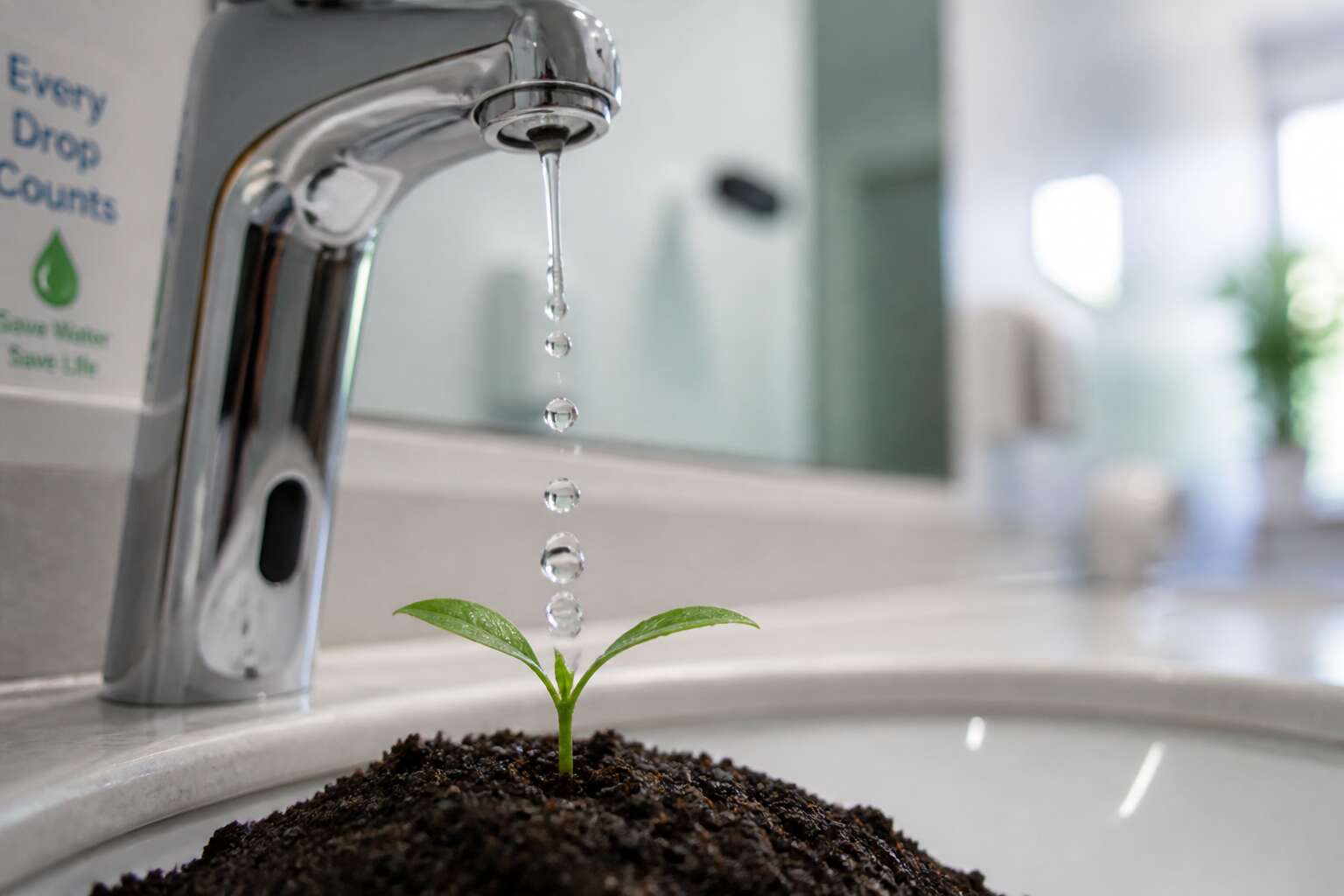
The Importance of Water Conservation
Global Water Scarcity Facts
By 2025, half of the world’s population will live in water-stressed areas. That projection is our current reality. South Africa knows this intimately, having faced Day Zero in Cape Town. I have felt the weight of that crisis.
Water scarcity is a moral test. The United Nations reports that 2.2 billion people lack safely managed drinking water. For them, conservation is survival, not a lifestyle choice!
- Agriculture consumes 70% of global freshwater.
- Climate change disrupts rainfall patterns, worsening droughts.
- By 2030, water demand may outstrip supply by 40%.
When we examine water saving 5 points, we acknowledge that each drop carries responsibility. The importance of water conservation lies in our collective willingness to act before scarcity becomes permanent.
Environmental Impact of Water Waste
Wasting water is not a victimless act. Each drop that slips away forces municipalities to pump, treat, and heat replacements, which burns electricity and emits carbon. The environmental toll compounds silently.
Consider the natural world. When we overdraw from rivers and aquifers, wetlands shrink and species lose their breeding grounds. Water waste accelerates this depletion. The energy consumed to deliver clean water is often generated by fossil fuels, so every wasted litre is a small betrayal of the atmosphere.
My own inspections of irrigation systems revealed that leaks account for nearly a third of total urban water loss. Fixing them is the first of many water saving 5 points, yet the environmental payoff is immediate.
Economic Benefits of Saving Water
South African water rates keep climbing, and waste is the reason your bill grows faster than inflation. In my work with commercial properties, I have watched water bills outpace every other utility. The economic benefits of saving water extend far beyond the monthly statement.
Farmers feel this pressure most acutely. Every cubic metre of irrigation carries a price that affects crop viability. Municipalities also carry the burden of treating and pumping water that never reaches a tap.
- Reclaimed process water reduces procurement costs for factories.
- Efficient scheduling lowers pumping expenses on farms.
- Hospitality venues trim their largest utility lines.
The water saving 5 points framework targets these financial leak points directly! Municipalities that curb losses also defer expensive infrastructure upgrades, a dividend paid by conservation alone.
How Individual Actions Add Up
Every morning, millions of South Africans open a tap without thinking. That single gesture, repeated daily, defines our national water future. I have walked through homes in Cape Town where a leaking toilet cistern wasted twelve litres an hour. The owner never noticed. The system certainly noticed! The water saving 5 points framework treats individual behaviour as the starting point, and the water saving 5 points checklist belongs in every household. One person’s routine seems insignificant. A thousand people practising the same wasteful routine become a crisis. A thousand people practising restraint keep the reservoirs stable.
The work begins with small, unglamorous repairs:
- Fixing one dripping tap saves nine thousand litres a year.
- Reporting a burst pipe in your street saves the municipality hours of treated water.
- Harvesting greywater for your garden reduces demand on the system.
None of these actions changes the world alone. All of them together change the balance sheet of a nation.
Practical Indoor Water-Saving Tips
Fixing Leaks and Dripping Faucets
A single dripping faucet can waste over 11,000 liters of water annually. That is enough to fill a small paddling pool every single week, which is either a fun fact or a source of existential dread, depending on your water bill. Your home is likely harbouring a little aquatic snitch, a tap that leaks a slow, rhythmic confession of waste. This is not a mere annoyance; it is a direct drain on your supply.
A toilet that runs can be far worse than a dripping tap. This silent culprit hides behind a closed lid, performing a continuous, wasteful flush that you pay for but never see. You might hear a faint hiss or a periodic trickle, the sound of your water pressure quietly giving up. Start by listening in each bathroom for a few minutes of silence.
Common offenders include:
– A worn-out rubber washer in a faucet handle.
– A misaligned float valve in the cistern.
– A corroded pipe joint under the sink.
Fixing these is often a simple task of replacing a cheap washer or adjusting a floating arm. It costs a few rand and takes about ten minutes. A properly sealed system is the foundation of any serious effort, so consider this the first and most profitable step. If you are tallying up your water saving 5 points, this is point one, and it is the easiest one to bank.
Upgrading to Water-Efficient Appliances
Your indoor water habits are a private performance, and the audience is your meter. The humble showerhead can discharge more water in five minutes than a century of polite handwashing. A modern water-efficient model, one with a flow rate under nine litres per minute, changes that arithmetic.
Appliances carry the heavy weight in this show. An old washing machine may guzzle 150 litres per load, while a front loader uses half. Dishwashers and toilets follow the same pattern. When you build your water saving 5 points, this indoor upgrade becomes the point that pays dividends every day.
- Dual-flush cisterns with a half flush option.
- Aerators on taps that mix air into the stream.
- Rainwater harvesting systems for your garden hose.
These devices are standard engineering solutions, not luxury extras. South Africa’s water tariffs climb each year, so every litre retained is a rand kept. The water saving 5 points list turns into a practical manifesto for your household.
Smart Bathroom Habits
Think of the morning ritual as a series of choices, each one a quiet conversation with your meter. A running tap can spill twelve litres in a minute, a volume that would sustain a small garden for a day. The water saving 5 points takes root in these unremarkable moments. Shave with the basin plugged, using a shallow pool rather than a constant stream. Let the brush pause while the tap rests. A shower of three minutes, not nine, returns a small fortune over a year.
A few gestures carry real weight:
- Turn the tap off while soaping hands or scrubbing your face.
- Catch the cold water that runs before a shower and redirect it to a bucket.
These are recalibrations, not sacrifices.
Kitchen Water-Saving Practices
In the kitchen, water waste often arrives quietly, from a tap left running while scrubbing a pan. South African households face municipal pressure dips, so every litre diverted to a bucket instead of a sewer line counts. The water saving 5 points reaches this room through tactical choices. Wash vegetables in a partially filled bowl rather than under the faucet, then tip the bowl’s contents into a watering can. For dishwashing, soak plates in a basin before any rinsing, and use that same basin water to flush a toilet.
- Keep a flask of cold water in the fridge to avoid running the tap for a drink.
- Collect pasta water in a heatproof container; once cool, it can refresh plants.
These adjustments cut usage without altering the rhythm of cooking.
Reusing Greywater at Home
A shower loses up to nine litres per minute down the plughole. Yet that same cloudy water, caught by a diverter valve, can refill a toilet cistern or a scrub bucket. In South African flats, indoor greywater reuse avoids the afternoon heat, keeping stored water cool and clear of insects. A washing machine’s final rinse, the bath’s shallow leftover, and the basin’s soapy pulse can all flow to a holding tank beneath the sink.
- Bathwater, filtered once, held for a single day
- Washing machine rinse water pumped to the cistern
- Basin water routed to a spray mop unit
The water saving 5 points rests on this closed loop. A basic pump, a screen filter, and short pipes do the work, and the household’s rhythm stays intact.
Outdoor Water Conservation Methods
Smart Lawn Irrigation Techniques
In South Africa, rainfall is unpredictable and drought is common. I have seen sprinklers run at noon, losing much water to evaporation. Smart irrigation is about watering with intention, not about watering more!
Soil moisture sensors measure the soil’s dryness before releasing a drop. Weather-based controllers adjust to current conditions. For the water saving 5 points, outdoor methods matter as much as indoor habits. A lawn watered deeply but rarely grows roots that tolerate heat.
- Water early morning to reduce loss from wind and sun.
- Group plants with similar needs into hydrozones.
- Use drip lines for flower beds, not sprinklers.
Each season has a different rhythm. In Cape Town’s dry summers, raise the mower blade to shade the soil. This reduces evaporation and keeps grass resilient. Smart irrigation coordinates the garden’s needs with available water, and every kiloliter saved protects the public supply.
Rainwater Harvesting Systems
A single summer storm over an average Johannesburg roof yields more than a thousand liters. Rainwater harvesting captures this resource before it becomes runoff. This practice is among the most effective outdoor water conservation methods.
The system is direct: gutters channel rain into a storage tank, while a mesh filter blocks debris. For drinking quality, install a first-flush diverter to discard the initial dirty water. The stored supply flows by gravity or pump to garden beds.
- Storage tank size matches roof area and rainfall
- Gutter guards prevent leaf buildup
- Overflow pipe directs excess away from foundations
When reviewing water saving 5 points, every tank liter replaces municipal water for irrigation. Harvested rainwater contains no chlorine, which benefits soil microbes. It also reduces stormwater runoff that carries pollutants toward rivers.
Drought-Resistant Landscaping
Adapting a garden to drought is an admission that water is finite. The veld grass and aloes already understand this. Drought-resistant landscaping does not fight the landscape; it concedes to it. Choosing indigenous species reduces demand on municipal supplies.
This approach can be measured. A bed of succulents and wild grasses requires a fraction of the irrigation needed by a lawn. Mulched soil retains moisture longer. Within the water saving 5 points, this method matters. The mind, too, retains responsibility.
Each hardy choice is a quiet shift away from waste. The garden becomes a refuge for insects and birds, turning restraint into ecological generosity.
Pool Water Maintenance Tips
An uncovered swimming pool in Johannesburg can lose 2,000 litres each month to evaporation. That water disappears into the dry air, never reaching the garden or the tap. Outdoor water conservation starts with this awareness. The pool is often the biggest offender on a property. A simple pool cover cuts evaporation by nearly half, especially during winter when the pool sits untouched for weeks.
Weekly checks reveal hidden leaks. A dripping pump seal or cracked liner becomes a slow, invisible drain on household reserves. Consistent pool water maintenance relies on a few deliberate habits:
- Inspect the pump seals and liner for seepage
- Keep the water level below the skimmer’s mouth
- Backwash the filter only when the pressure gauge demands it
Beyond the pool, hoses deserve scrutiny. A hose left running for ten minutes wastes more than a typical shower. Sweeping the driveway with a broom instead of a jet of water is a small habit with measurable results. These quiet adjustments turn the water saving 5 points approach into a lived practice.
In South Africa, where rainfall patterns grow less predictable, every litre kept in the ground matters. Water saved outside the house is water kept in the earth.
Washing Cars and Driveways Wisely
Every minute a hosepipe runs, it pours out about fifteen litres of potable water. A bucket and sponge can wash a car with less than twenty. The driveway needs no water at all; a stiff broom lifts dust and grime without creating runoff that carries pollutants into storm drains. For the rare rinse, a trigger nozzle stops the flow the instant your hand releases it.
Consider the order of operations.
- Sweep the driveway thoroughly before any washing begins.
- Wash the car using a bucket of soapy water, starting from the roof downward.
- Rinse with the trigger nozzle, working in sections.
- Sweep once more to clear any residue.
This sequence turns a chore into a deliberate act of stewardship. It embodies the water saving 5 points approach, where every litre has a purpose.
Technological Innovations in Water Efficiency
Smart Water Meters and Leak Detectors
Between the municipal main and your property line, thousands of litres disappear every year. Smart water meters expose exactly where that water goes. They record usage in hourly increments, revealing patterns a monthly meter reading would never show. Some South African municipalities now offer remote reading systems that detect anomalies before they become disasters.
Leak detectors add another layer of defence. These devices monitor flow continuously and identify when water runs while everything is switched off. They speak directly to an app on your phone, so nothing waits for a quarterly statement.
- Real time usage alerts
- Automatic shutoff valves
- Detection of silent toilet leaks
For South African homes facing rising tariffs, this technology turns the water saving 5 points from theory into practice. One Johannesburg homeowner detected a slab leak wasting 400 litres per day within hours of installation. That is the sort of discovery that changes a water bill entirely!
Low-Flow Fixtures and Aerators
Showerheads and taps run quietly, but their demand on municipal supply is loud. A standard showerhead releases up to 15 litres per minute. Low-flow fixtures cut that to six litres or less. Aerators, small mesh discs placed inside tap nozzles, blend air into the water stream. Pressure stays steady while volume falls.
- Tap aerators cut water use by half on sinks
- Low-flow showerheads save roughly 5 litres per minute
- Dual-flush cisterns reduce toilet water consumption significantly
These devices require no lifestyle shifts. Fit them, turn on the tap, and the savings begin. For South African homes facing rising utility costs, such straightforward upgrades become the water saving 5 points in hardware form.
Advanced Irrigation Controllers
Municipal water supply in South Africa faces its steepest demand during summer evenings, when thousands of sprinklers run simultaneously. Advanced irrigation controllers break this pattern by responding to actual conditions rather than clocks. They connect to weather services and on-site sensors, calculating precise watering needs for each zone. A controller can delay a scheduled cycle if wind speeds threaten drift or if soil moisture remains sufficient.
- Decentralized scheduling for shaded versus exposed areas
- Automatic seasonal adjustments based on evapotranspiration
- Integration with municipal restriction alerts
These devices record historical usage and allow property owners to monitor consumption in real time. For anyone tracking water saving 5 points, this visibility provides documented proof instead of guesswork.
Water Recycling and Desalination Trends
Less than 20% of South Africa’s municipal wastewater is reused, a figure that should worry every resident. Desalination trends have moved past the era of giant coastal plants. The new focus is modular and local:
- Solar powered units that work off grid in rural coastal towns
- Industrial recycling loops that return treated effluent to factory pipelines
- Atmospheric water generators that pull moisture from morning fog in the Karoo
These systems do not wait for central authority. For anyone tracking water saving 5 points, the metric is clear: fewer litres drawn from dams, more litres kept in circulation. Real time monitoring adjusts energy use and chemical dosing automatically. The technology is not cheap yet, but it is getting smaller and smarter every season.
Community and Policy Approaches to Water Saving
Government Regulations and Incentives
South Africa’s water crisis demands more than individual virtue. Policy levers shape behaviour at scale. Cape Town’s tiered tariff structure punishes excessive use while rewarding conservation. Nationally, the Department of Water and Sanitation sets regulations that create a shared sense of urgency. Yet incentives matter equally. Rebates for rainwater tanks and greywater systems ease the upfront cost of sustainable choices.
Municipalities that offer free water audits or subsidised smart meters see measurable reductions in consumption. I have watched communities thrive when local governments combine enforcement with encouragement. Consider how the water saving 5 points framework translates into civic action. Households respond when the system rewards them, and resident associations often secure better access to funding.
Policy succeeds when it feels collaborative. Government must pair regulation with education, and incentives with accountability.
Community-Based Water Management
In a small Karoo village, I watched neighbours turn one shared tap into a rotating system. They each filled only two buckets before dawn, then passed the hose to the next house. Within a month, daily water use dropped by a third. It worked surprisingly well!
Community based water management depends on transparent communication. Residents in Makhanda formed a committee that maps every leak and repair using public chalkboards. The boards also list who owes a shared labour hour. That forces honest accounting without shame.
- Coordinate borehole schedules across farms
- Share drought alerts through neighbourhood WhatsApp groups
- Combine funds to buy communal water tanks
These practices show the water saving 5 points as a communal benchmark. People who conserve together often hold each other accountable more effectively than any law.
Corporate Water Stewardship Programs
When Cape Town faced Day Zero, corporate water users did not wait for the city to act. Breweries, mines, and textile plants published their usage data weekly. They adopted the water saving 5 points as a baseline for reporting to investors and regulators. Transparency became a competitive advantage.
Corporate water stewardship operates beyond factory gates. I have seen companies fund wetland restoration and repair leaking municipal pipes in the towns where they operate. They share borehole data with farmers and pay for streamflow monitoring. A practical program looks like this:
- Set a public reduction target with quarterly audits
- Map water risk across every supplier
- Contribute to catchment rehabilitation funds
- Report failures with the same clarity as successes
These programs work best when executives treat water as a shared resource. The water saving 5 points give them a common language with municipalities and community boards. Stewardship does not stop at compliance. It builds resilience into the entire supply chain.
Educational Campaigns and Awareness
Educational campaigns in South Africa gain traction when they pair policy with presence. Community halls host practical demonstrations, while municipal newsletters translate the water saving 5 points into household language. A single trusted facilitator can shift more behaviour than a year of billboards.
- Fund local facilitators to teach water conservation methods
- Display district consumption trends at clinics and schools
- Link small rebates to verified household savings
Policy performs the follow-through. When municipalities publish raw data on leaks and streamflow, awareness becomes a civic tool rather than a slogan. In my own suburb, the shift came when a neighbour showed me her monthly consumption graph. That sustained attention turns information into shared habit.
Developing a Sustainable Water-Saving Routine
Setting Personal Water Reduction Goals
I started my water-saving journey with a notebook and a stubborn curiosity about my household’s hidden consumption. What I found surprised me: small habits, repeated daily, accounted for most of the waste. Developing a sustainable water-saving routine begins with that kind of honest observation. You cannot reduce what you have never measured.
Set personal water reduction goals that feel achievable, not punishing. A realistic target for a family of four might be a 15 percent drop over three months. Break that goal into weekly checkpoints. Consider these water saving 5 points when structuring your routine:
- Record meter readings every morning
- Keep a shower timer nearby
- Reuse cooled pasta water for plants
- Run the dishwasher only when full
- Track weekly totals on a visible chart
These actions build a rhythm. Over time, the routine becomes automatic, and the goals become a quiet source of pride.
Tracking and Monitoring Water Usage
Households that monitor consumption reduce water use by up to 20 percent, yet most South African homes never read their meters. In a country where reservoirs shrink without warning, tracking water usage becomes a necessary obsession. I have watched households double their consumption without a clue where it went. A meter reading is a number that reveals how much we took and how much we wasted. Monitoring is not punishment. It is the only honest way to know if a routine actually works.
A thirty day diary of readings taken at the same hour each morning, with notes on the weather, the number of guests, and the laundry loads, explains the fluctuations and makes excuses unnecessary.
This discipline gives the water saving 5 points a concrete purpose. You begin to see where the 15 percent target is met, and where the water is lost.
Building Family and Workplace Engagement
Sustainable routines rarely survive willpower alone. They need structure, shared accountability, and a visible place in daily life. When I helped my own household adopt a water saving 5 points plan, the turning point was making the routine tangible. A simple chart on the kitchen wall, with each person’s initials and a weekly target, turned abstract saving into a small competition. My children began reminding me to switch off the hose before I reached the tap. That shift, from nagging to ownership, is the entire battle.
Workplaces demand a different mechanism. Colleagues respond to peer pressure and tangible results, not lectures. Building engagement means assigning a water champion in each department, someone who shares the monthly reading and acknowledges small victories. One office I consulted reduced consumption by 12 percent after installing a communal dashboard in the tea room. The water saving 5 points framework only functions when everyone sees their contribution counted, and when the routine belongs to the group, not the building manager.
Adapting to Seasonal Changes
South Africa’s climate follows its own cadence. Cape Town receives winter rainfall while Gauteng waits for summer thunderstorms, and a conservation routine that ignores this rhythm will fall apart. A water saving 5 points strategy must adapt to the seasons, not fight them. What works in February’s heat becomes useless by June’s chill.
In wet months, focus shifts to capturing what falls freely. Check gutters, direct downspouts toward garden beds, and let irrigation rest. In dry months, every drop demands scrutiny. Adjust washing cycles, shorten showers, and repurpose cooking water. The water saving 5 points checklist becomes a seasonal artefact, revised with the first frost or the first downpour.
My own household recalibrates quarterly, changing timers and habits as the weather turns. The discipline lies in observing the landscape and responding without delay.
Celebrating Milestones in Conservation
A routine only survives the ordinary Tuesday. South Africans accept 237 litres per person per day as normal until dam levels drop. The water saving 5 points framework gives structure to this challenge. It breaks conservation into manageable pieces instead of leaving it as an abstract anxiety.
Celebrating milestones is often skipped. You fix a leaking toilet, install a rain tank, then forget the progress. I write mine down. A notebook entry, “July: saved 800 litres,” beats a grand gesture. Worthwhile milestones include:
- First month with a full rain tank
- A reduction in your municipal bill
- Completing a water saving 5 points checklist twice without missing a step
Recognition reinforces behaviour. Celebrating small victories builds endurance for long-term conservation. The routine stops being a chore. It becomes a quiet habit, measured in litres and marked in moments.


0 Comments