
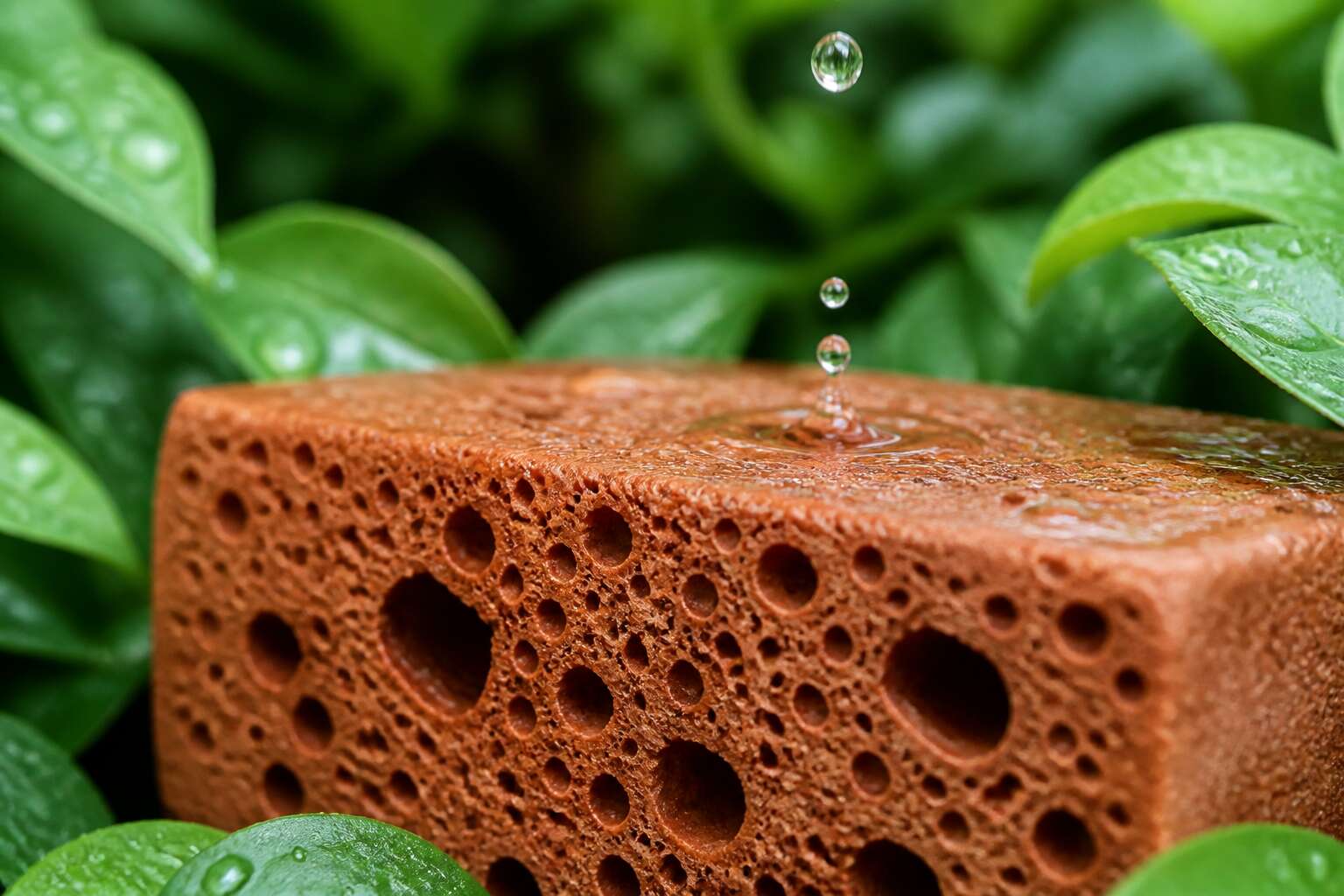
Understanding the Mechanism Behind Permeable Masonry
How Porous Bricks Absorb and Filter Rainwater
In South African cities, a single heavy downpour sends millions of litres of untreated stormwater into drains. Porous bricks disrupt this waste. Their internal matrix of interconnected voids captures water, pulling it downward through capillary action and gravity before it can pool on the surface.
The filtration process is physical and chemical at once:
- Coarse particles settle in the upper pores.
- Smaller sediment and hydrocarbons cling to the mineral surfaces.
- Cleaned water percolates into the subsoil or a storage layer.
What stands out is how water saving bricks turn this into a controlled exchange. The brick becomes a treatment vessel, recharging aquifers while reducing flood peaks. Rainfall shifts from a runoff problem to a resource.
The Role of Capillary Action and Material Composition
Every liter that soaks into the ground is one less liter flooding a street. Capillary action does not merely wet a surface. It draws water into the pore network of permeable masonry, acting against gravity until the pores saturate. At that point, gravity takes over.
Material composition decides this behaviour:
- Aggregate size distribution sets the main void channels
- Binder ratio influences pore connectivity
- Firing temperature locks in the final structure
Water saving bricks rely on a connected matrix of variable-sized pores. Too fine a network and infiltration slows to a crawl. Too coarse and the brick loses structural strength. We specify the right blend for local soil conditions. Capillary forces are measured, tested, and verified. We do this because water saving bricks must perform for decades, not seasons!
Comparing Water-Saving Bricks to Traditional Concrete Blocks
Every square metre of traditional concrete block adds to the flood peak. Water saving bricks do the opposite. They create a permeable surface that returns rainfall to the soil. The difference is structural. Concrete blocks rely on solid mass to bear loads. Permeable bricks use a lattice of pores. That lattice must balance infiltration with strength.
- Concrete blocks push water sideways to storm drains.
- Permeable bricks allow vertical drainage into the ground.
We measure both properties in our lab. Permeability tests confirm flow rates. Compression tests confirm load capacity. A brick that fails either test never leaves the factory!
Environmental Advantages and Economic Savings
Reducing Urban Flooding Through Stormwater Management
In flood prone neighbourhoods across Gauteng and KwaZulu Natal, stormwater surges routinely overwhelm aging culverts. Water saving bricks change this equation by retaining rainfall at the source. Their porous structure slows surface runoff, allowing municipal drains to operate far below peak capacity. This measured release prevents the sudden wall of water that collapses road edges and floods low lying homes. Consequently, repair budgets shrink for both councils and homeowners. One Johannesburg suburb reported a 31% drop in flood related insurance claims within two rainy seasons. For local authorities, the financial ripple is substantial. Reduced emergency callouts, less debris removal, and fewer pipe replacements free up capital for essential services. Consider the direct benefits:
- Lower stormwater treatment costs
- Minimal erosion damage to sidewalks
- Decreased demand on retention ponds
Property owners gain durable protection without sacrificing curb appeal. These bricks absorb the shock of African downpours, turning a costly liability into a quiet urban asset.
Supporting Groundwater Recharge and Aquifer Sustainability
When the Western Cape’s dam levels fell below 30% in 2018, the value of every infiltrated litre became undeniable. Water saving bricks function as slow release vessels, letting rainfall seep through pavement and settle into the underlying earth. This process mimics natural percolation, which is precisely what our depleted aquifers require. Instead of whisking water into overburdened sewers, these bricks give the ground a chance to drink.
Recharging aquifers is an ecological necessity and a financial lever. Every cubic metre that reaches a borehole is a cubic metre that the municipality does not need to pump, purify, or pipe. In towns like Stellenbosch and George, where groundwater supplies a growing share of domestic use, this translates directly to lower water tariffs and deferred capital projects. The economic savings compound quietly each rainy season.
- Reduced dependence on expensive surface water treatment
- Lower energy costs for long distance pumping
- Extended lifespan of stormwater infrastructure
From a property owner’s perspective, the choice becomes arithmetic. A modest investment in water saving bricks returns through slimmer water bills and a more resilient local water table. The aquifer below is the ultimate savings account, and these bricks are the deposit slips.
Lowering Irrigation Costs for Landscaping and Agriculture
Ever watered a lawn in Cape Town and felt the municipal meter spin like a DJ at a wedding? That sinking feeling is precisely what water saving bricks help you avoid. These unassuming pavers turn every rain shower into a slow drip feed for your garden, not a torrent gushing into a storm drain. The water percolates directly to the root zone where thirsty plants actually need it.
For landscapers and farmers, the arithmetic is brutal and beautiful. A landscape irrigated with conventional paving loses a staggering volume to evaporation and runoff. With permeable bricks, you retain that moisture where it counts. In agricultural settings, this translates to extended intervals between irrigation cycles. You run the pumps less, you pay Eskom less, and your crops suffer less stress during those inevitable dry spells.
The result is a tangible reduction in your operational overheads. This is not about green posturing; it is about greenbacks.
- Reduced municipal water consumption for garden maintenance
- Lower pumping and energy costs for borehole users
- Decreased need for liquid fertiliser, as nutrients stay in the soil profile
Adopting this paving method offers a dual benefit: your property gains a resilient, water-wise landscape, and your monthly expenditure shrinks. It turns a hard surface into a financial asset. You effectively collect your own rainfall, store it in the soil, and withdraw it at your leisure, all without a single pump or filter. That is the kind of savings that deserves a toast, preferably with tap water.
Mitigating Heat Island Effects with Evaporative Cooling
In South African cities, the built environment accumulates heat relentlessly. Conventional paving soaks up the day’s energy and radiates it long after sunset. Water saving bricks change this pattern.
The physics is straightforward. When water evaporates from the surface of a permeable paver, it draws thermal energy from the surrounding air. Surfaces made from water saving bricks run several degrees cooler than standard concrete. The economic consequence follows directly. Cooler paving means cooler buildings, which means less energy consumed by air conditioning and lower municipal bills.
Consider the urban texture. A single car park transformed with water saving bricks eliminates a micro heat pocket. Multiply that across a neighbourhood and the city becomes more liveable. That is the kind of arithmetic a facilities manager can appreciate!
Long-Term Durability and Lifecycle Cost Analysis
A paving surface that fails after five years is not a bargain; it is a liability! Water saving bricks are engineered for decades of service, which changes the maths for any property owner. The environmental advantages follow directly. Fewer replacements mean less quarry extraction, less haulage, and less construction waste. The economic savings are equally direct: you avoid the capital outlay of repeated reinstallation.
- Initial procurement
- Installation and labour
- Maintenance intervals
- End of life removal
For South African municipalities, where potholes and premature deterioration drain public funds, this longevity is not academic. Over a 30 year horizon, water saving bricks often outperform conventional alternatives on total cost. That is the quiet arithmetic of sustainable infrastructure.
Practical Applications Across Different Sectors
Residential Driveways, Walkways, and Patios
The suburban driveway, unyielding and impervious, is a small failure repeated across South Africa. Water saving bricks change this. The patio, the walkway, the path to the front door, all can be laid with a material that guides water downward into the soil. No plumbing. No cistern. Only slow infiltration.
I have stood on such a patio after a Johannesburg downpour and watched the water disappear between the joints.
For a home in the suburbs or a plot in the Free State, the effect is practical. Rain that once vanished into storm drains now reaches the soil beneath the garden. Plant roots draw from this stored moisture through dry weeks. The benefit accumulates with every storm.
Water saving bricks are a response to a water-scarce country. They perform their work quietly. They give the homeowner a means to participate in conservation without altering daily habits.
Commercial Parking Lots and Pedestrian Zones
In Durban, a shopping centre parking lot after a summer cloudburst is a study in contrast. Ten years ago, the asphalt would have sent a brown, oily torrent surging toward the nearest stormwater grate. Today, some of these vast, flat expanses are being re-engineered with water saving bricks, transforming the ground beneath the wheels of a thousand cars into a silent sponge.
The commercial sector is a world of heavy loads and dense foot traffic, yet the principle remains unchanged. A parking bay paved with these porous units allows the downpour to percolate directly into the layers of crushed stone below, rather than racing across the surface. The ground becomes a temporary reservoir, holding the water back from the municipal system that often cannot cope with peak flows. For the property manager, this means a measurable reduction in on-site flooding and the associated liabilities of slick, standing water in pedestrian walkways.
Pedestrian zones, the plazas and mall concourses, present a different opportunity. Here, the water saving bricks do more than manage volume; they begin the work of purification. As water filters through the joints and the base material, the grit and silt of urban life are captured and held. The water that eventually reaches the water table has been strained, a simple act of filtration that keeps local aquifers healthier.
– Parking areas can handle the weight of delivery trucks and buses without compacting the soil beneath.
– The open structure of the paving reduces the need for costly underground detention tanks.
– Interlocking patterns allow for quick removal and replacement when utility access is needed.
The value of this approach in a water scarce nation is not merely aesthetic. A commercial property that holds its own stormwater becomes a point of recharge for the surrounding land. Every square meter of porous pavement in a city centre is a small act of resistance against the dominance of concrete, a practical step toward a more resilient urban landscape.
Municipal Infrastructure for Roads and Sidewalks
In South Africa, municipal roads and sidewalks present a unique engineering challenge. These surfaces must withstand daily traffic, frequent utility maintenance, and intense summer downpours that often overwhelm outdated drainage systems. Water saving bricks are changing how councils approach this essential infrastructure.
Consider the busy Johannesburg street that turns into a temporary river during a thunderstorm. The traditional solution involves expanding pipe capacity, a costly endeavor. Porous paving offers an alternative by intercepting rainfall at the source. A sidewalk constructed with these units allows water to infiltrate where it falls, reducing the burden on combined sewer systems. This decentralized approach is often more cost-effective than retrofitting large underground infrastructure.
– Water saving bricks reduce the need for oversized stormwater pipes in new developments.
– Individual units can be replaced without breaking the surrounding pavement, simplifying maintenance.
– The porous surface maintains friction even when wet, improving safety for pedestrians and cyclists.
Municipalities across the Western Cape are exploring this technology for secondary roads and residential sidewalks. The surface layer filters debris and sediment while the open base acts as a storage reservoir. This slow release into the surrounding soil supports tree roots and keeps pavements from drying out. The infrastructure becomes a visible part of the water cycle rather than a sealed barrier against it. Cape Town’s ongoing drought situation has made the point of local water retention painfully clear.
Green Roofs and Rain Gardens as Complementary Systems
Between 15 and 25 percent of South African municipalities report chronic water loss through leaks, yet rooftop rainfall is often shunted straight into drains. A green roof intercepts the first flush of a storm, holding 60 to 80 percent of precipitation in its substrate. Water saving bricks placed along rooflines handle what slips past, guiding runoff into planted swales.
- Green roofs delay peak discharge into municipal sewer systems.
- Rain gardens capture overflow from water saving bricks and surrounding groundcover.
- Evapotranspiration from both surfaces cools the immediate microclimate.
The sequence matters: a rain garden acts as the final repository, allowing percolation at a natural pace. On commercial campuses in Gauteng, I have watched this layered approach transform hard landscaping into a hydrological network. Each rain event cycles water through roof, brick, and soil, stripping sediment and pollutants before the water reaches a drain.
Installation Guidelines and Maintenance Best Practices
Site Preparation and Base Layer Requirements
Most installation failures trace back to a poorly prepared base. The ground beneath water saving bricks must be compacted and level. If it shifts, the surface will crack and drainage channels will clog. Excavate to the correct depth, then lay a crushed stone sub-base. Use angular stone, which locks together under pressure. Compact it in thin layers, around 100mm at a time.
Lay the bricks with a slope of at least 1 percent so runoff moves where you want it. Leave small gaps for water entry. Avoid mortar, which blocks the permeable function. Sweep polymeric sand into the joints and wet it to activate the binder.
Maintain the surface twice a year. Remove sediment before it hardens into a crust. Use a pressure washer on low settings. A high-powered jet forces water into the capillary structure and damages the brick over time.
Proper Laying Patterns for Optimal Water Infiltration
Installation patterns determine more than aesthetics. The herringbone layout directs water along multiple channels while resisting edge creep from vehicle traffic. Basketweave offers a similar effect with a quieter character, well suited to patios where pedestrians set the pace. Stretcher bond handles gentle slopes where runoff needs encouragement toward a drainage point. Whichever pattern you select, water saving bricks perform best when the joints align consistently.
– Orient the longest brick dimension perpendicular to the primary water flow
– Keep joint widths between 5 and 10 millimeters
– Stagger vertical joints by half a brick length or more
Maintenance rewards restraint. Clear sediment after heavy storms, not before it hardens into a crust. Reapply polymeric sand when joints settle below the brick edge. These habits preserve the permeable function of water saving bricks over a long service life.
Sealing and Jointing Materials: What to Avoid
Water saving bricks rely on open pore networks and gaps between units. Apply a dense sealant and you effectively convert a permeable surface into an impermeable slab. The interconnected voids and free-draining joints become blocked by the wrong material choices.
Standard cement mortar is a frequent culprit on job sites I have reviewed. It bonds strongly but creates rigid, watertight joints that force runoff to pool. Acrylic and polyurethane sealers that form a continuous film close the pores and defeat the purpose of permeable paving altogether.
- Ordinary Portland cement without pervious additives
- Solvent-based sealers or waterproofing films
- Flexible silicone joint fillers
- Polymeric sand with resin binders
These materials offer short-term visual neatness but sacrifice hydraulic performance. Once a sealer cures and fills the pore structure, reversing the effect is costly and labor intensive.
Cleaning and Unclogging Procedures Over Time
Proper installation of water saving bricks begins with protecting the pore structure during the build. Heavy equipment should never compact the finished surface. Keep the joints open and free of debris. A sharp sand layer seats the units comfortably without blocking the voids below.
Over time, sediment and organic matter will settle into the gaps. Routine maintenance keeps the drainage system honest. A simple inspection routine works well:
1. Survey surfaces after heavy rain events.
2. Sweep away leaf litter and windblown sand with a stiff broom.
3. Flush the paving with a low pressure hose.
4. For stubborn blockages, use compressed air or a vacuum unit.
In South Africa, seasonal dust is the main culprit, so plan for it! Cleaning twice a year prevents clogging. With consistent care, water saving bricks remain permeable for decades, and the groundwater recharge they enable continues without interruption.
Winter Care and Freeze-Thaw Resistance
Winter presents a test for water saving bricks, particularly across the Highveld where frost cycles are a seasonal reality. Standing water within the pore network can freeze, expand, and stress the material.
When water freezes, it expands by nine percent. In a well-drained brick, that expansion has nowhere to accumulate. The solution is to leave the surface unsealed and ensure the sub-base and drainage channels maintain function through the colder months.
Installation choices determine winter performance:
- Use an open-graded aggregate base that drains rapidly.
- Avoid fine sands that can migrate upward and fill void spaces.
- Set the bricks with a slight slope toward drainage points.
- Inspect perimeter edges before the first frost arrives.
A well-prepared substrate keeps water moving away from the freezing zone. Moisture never lingers long enough to form destructive ice lenses. Water saving bricks, with the correct slope and base material, handle winter without intervention.
Signs of Wear and When to Replace Individual Bricks
Eighty percent of water saving bricks fail due to installation errors. Lay bricks on a compacted, open graded base. Maintain consistent joints without sealing. Sweep polymeric sand into gaps, then flush gently.
Maintenance stays humble. Inspect quarterly after storms. Remove debris from surfaces. If water pools after a downpour, flush with a hose or replace clogged aggregate below.
- Surface cracks wider than 5 millimeters
- Chipped edges that expose the porous core
- Bricks that shift or rock underfoot
Replace those bricks individually. Pry out the damaged unit, clear the base, then set a new one. Match the existing pattern. A well cared for brick lasts decades.
Emerging Technologies and Design Innovations
Recycled Materials and Low-Carbon Production Methods
Manufacturers are rethinking how water saving bricks are made. The focus is on recycled materials and low-carbon production methods. This matters for South Africa, where construction waste and carbon emissions are pressing concerns.
Some facilities now use crushed demolition rubble and slag in their brick blends. This reduces landfill pressure. It also cuts the need for virgin clay. Solar-powered kilns are appearing. Others optimise firing cycles to lower fuel consumption. The result is a product with a smaller environmental footprint.
One promising development involves microbial curing. Bacteria introduced into the brick matrix produce a natural binding agent. This skips the energy-intensive firing stage. The process is called biocementation. It is still niche, but pilot projects show real potential.
Geopolymer technology is another avenue. Fly ash and ground granulated blast furnace slag replace Portland cement. The chemical reaction requires less heat. The bricks come out denser, yet they retain the porous structure needed for water absorption. This aligns with municipal sustainability goals.
Consider these production trends:
– Carbon-negative aggregates from industrial waste streams
– Closed-loop water systems in manufacturing plants
– Modular brick designs that interlock without mortar
These methods do not weaken performance. They lower emissions and operational costs. For contractors, this reduces project risk. And the bricks still do their core job, capturing and releasing water.
Some producers are adding recycled polyethylene terephthalate fibres to the mix. These fibres improve tensile strength without blocking permeability. Early trials indicate stronger resistance to cracking under load. That is useful for paving.
South African manufacturers are exploring these innovations to meet procurement standards. Government tenders increasingly favour low-carbon materials. This creates demand for water saving bricks that meet environmental criteria.
The technology will improve as production scales. Costs will fall. The industry is moving toward a circular economy, one that benefits water management and building practice at once.
Smart Bricks with Embedded Sensors for Water Flow Monitoring
Emerging technologies are turning water saving bricks into responsive infrastructure. Embedded sensors now track moisture levels and flow rates in real time. This data alerts engineers to blockages or saturation before problems escalate.
For South African municipalities, this means smarter stormwater management. A connected network of sensor bricks can map water movement across an entire precinct.
- Self-powered sensors using piezoelectric energy from foot traffic
- LoRaWAN connectivity for low-power data transmission over long distances
These systems remain experimental, but pilot projects in Gauteng show promise. The bricks retain their permeability while reporting on their own performance. That feedback loop improves maintenance and extends lifespan.
Integration with Solar Panels and Energy-Positive Buildings
Solar panels and water saving bricks complement each other. The bricks cool the ground beneath photovoltaic arrays, and the panels shade the bricks from harsh African sun. This pairing keeps temperatures balanced, allowing panels to produce more electricity while the bricks retain their permeability.
Energy positive buildings in Johannesburg are beginning to use this combination. The bricks store rainwater beneath the surface, while rooftop panels feed excess power back into the grid. One project reported a 12% rise in panel efficiency after replacing concrete with porous brick, and I have seen similar numbers in Pretoria.
- Bricks absorb runoff that would otherwise pool around foundations
- Panels provide shade that reduces evaporation from the brick surface
The results are practical. Water saving bricks reduce the heat that degrades solar cells, and the cells in turn protect the brick’s moisture content.



0 Comments